
Understand and document your Natural & Adabas systems, decide with your specialists what to keep, and generate code, data structures and tests from that reviewed knowledge, with every rule traceable to its origin.

Decades of accumulated logic, hidden dependencies and limited documentation turn every change into a high-risk exercise.
Complexity slows execution, increases operational risk and leaves critical business knowledge trapped inside legacy code.
In Natural & Adabas, much of the data integrity lives in the application code, not in the database, which is why program-by-program migration so often falls short.
The risk isn’t migrating. The real risk is running a business no one truly understands.

It is about preserving business logic and building a new architecture without carrying forward unnecessary legacy complexity.
Translates existing code into another technology. It is fast, but risks reproducing the original structure and its accumulated complexity in the new system.
First understands and documents the system. Specialists then decide what to keep, change or retire, and new code is generated from that reviewed knowledge, with each rule linked to its origin and its tests.
Legacy Systems Analysis & Understanding makes your Natural & Adabas system visible and documented. Knowledge-Based Software Transformation turns that knowledge, once reviewed by specialists, into code, data structures and tests. We do not convert code line by line.
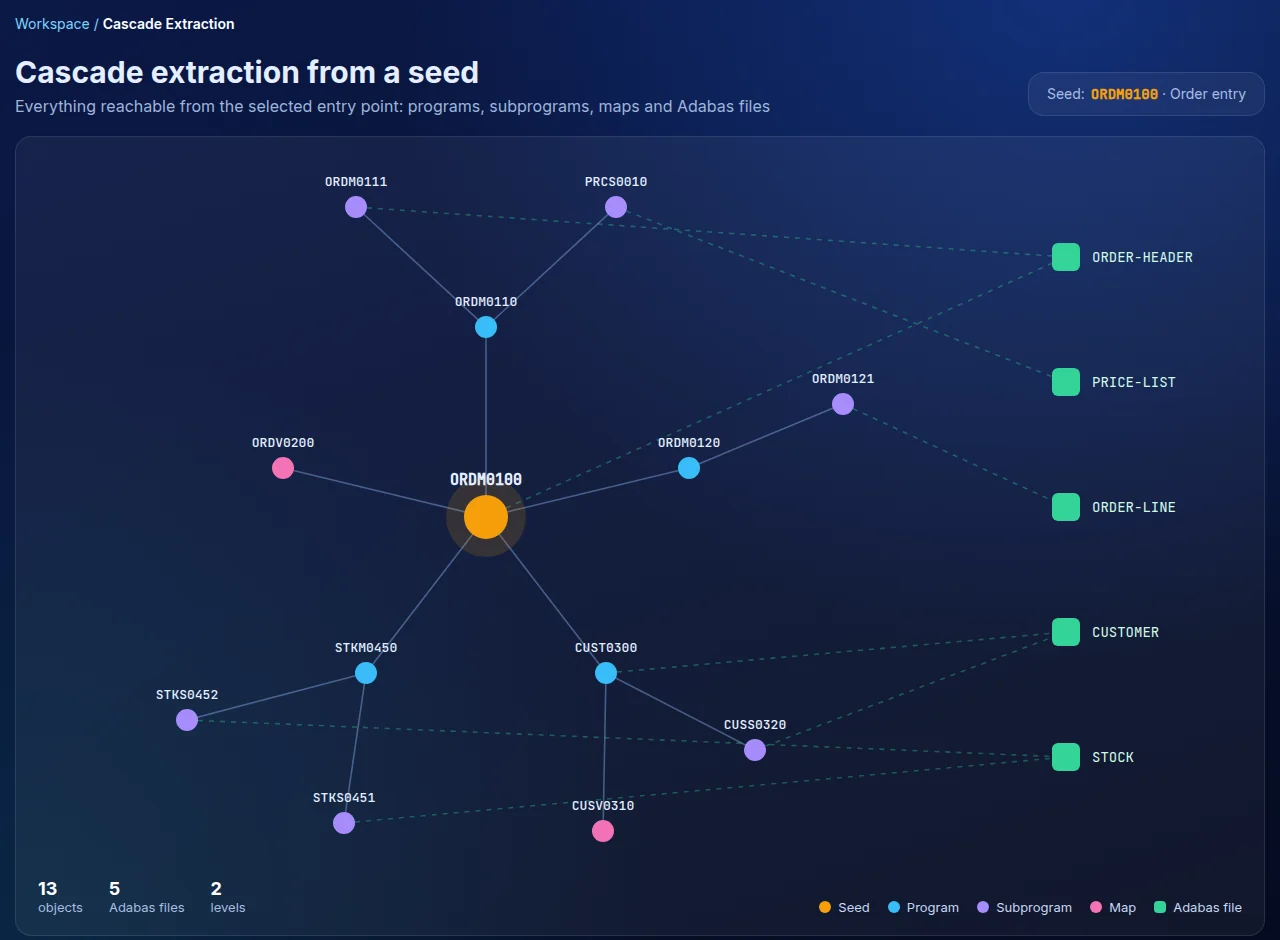
See how your system really works before changing it.
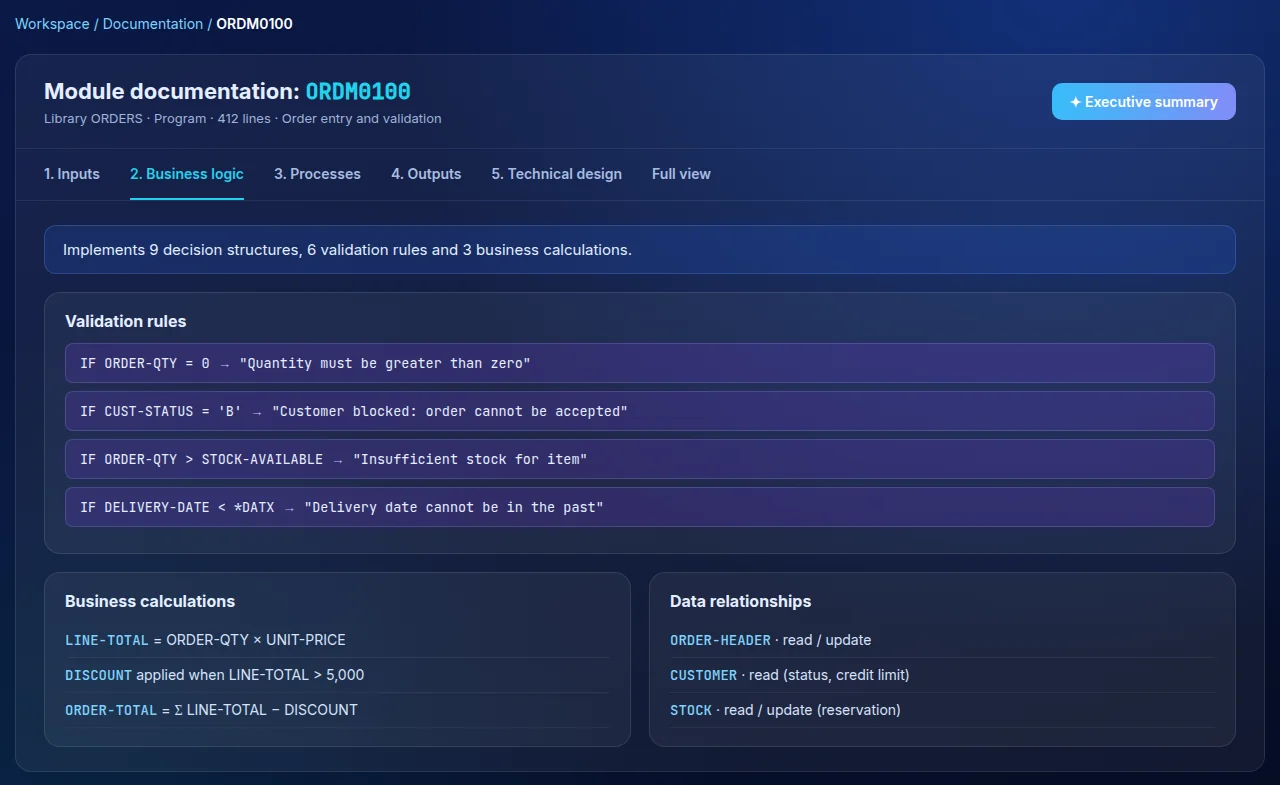
Recover the documentation the system no longer has.
Code built from reviewed knowledge, not translated.
Our approach generates code, data structures and tests from structured, reviewed knowledge, within the scope agreed for each project.
Illustrative screens with sample data.
A progressive, controlled path: each step builds on the knowledge recovered in the previous one.
Understand first. Then decide. Then generate and verify.
Inventory, dependencies between programs and data, and business logic, delimiting functional scopes from seed programs.
Technical and functional documentation for each module, organised with its origin so specialists can work from it.
Your specialists and ours review the documented knowledge and decide explicitly what to keep, change or retire. Each decision is recorded with its reason.
From the reviewed model, domain code, data structures with constraints, tests and documentation are generated for the agreed target technology.
Generated tests and traceability from each rule to its results, followed by progressive rollout by functional domain.
You decide what to keep, simplify, replace or retire, with the business logic documented before a single line of new code is generated.
Every rule that brings value is kept, with its origin and the decision behind it.
Knowledge held by a few experts becomes documented and shared.
See which programs share data and what a change affects before you make it.
Advance by functional domain, from seed programs, with evidence at each step.
Rules, decisions, code and tests linked, so changes can be reviewed, audited and maintained.
Modern code and data structures for the behaviour you decide to keep, without reproducing the old structure.

Demonstration screen with sample data. The figures shown are not customer results.
Legacy Bridge works through a progressive engagement model that starts from a representative seed and proves value early. Scope, acceptance criteria and expected results are agreed beforehand, and you decide at the end of each phase whether to continue.
The best modernization programs do not start with disruption. They start with structural clarity.
Agree on a representative case, its scope and success criteria, and analyse structure, dependencies and complexity.
A joint test on that case: understand, document, decide, generate and verify, measured against the agreed criteria.
Extend domain by domain according to the pilot results, with repeatable analysis, documentation and transformation under architectural governance.

Each member of our team brings more than 20 years of hands-on experience with Natural & Adabas, some over 30. Product specialists, developers, system architects, project directors and business leaders who have delivered and supported mission-critical Natural & Adabas environments. We know these systems from the inside, and that is what allows us to understand them before transforming them.
years of Natural & Adabas experience per team member
years in our most senior profiles
Product, development, architecture, delivery and business
Let’s explore how Legacy Bridge can turn your Natural & Adabas estate into documented knowledge and verifiable modern code.
